Filtering
This is a required Action:
-
Network operator defines a clear routing policy and implements a system that ensures correctness of their own announcements and announcements from their customers to adjacent networks with prefix and AS-path granularity.
-
Network operator applies due diligence when checking the correctness of its customer’s announcements, specifically that the customer legitimately holds the ASN and the address space it announces.
Most important is to secure the inbound routing advertisements, particularly from customer networks, through the use of explicit prefix-level filters or equivalent mechanisms.
Secondarily, AS-path filters might be used to require that the customer network be explicit about which Autonomous Systems (ASes) are downstream of that customer. Alternately, AS-path filters that block announcements by customers of ASes with which the provider has a settlement-free relationship can prevent some types of routing “leaks”.
Keep in mind that a common error is a typo in the announced IP addresses, which causes the wrong addresses to be announced from an allowed ASN. Filtering customer BGP announcements by AS-path filters alone is therefore insufficient to prevent catastrophic routing problems at a systemic level.
Similarly, filtering outbound announcements towards non-customer peers alone is insufficient where the operator provides services to multi-homed customers. Consider for example the scenario where a customer advertises a set of longer prefixes to only one of several transit providers: those longer prefixes will be learnt by that customer’s other providers via settlement- free peering or from their own transits, but since the prefix belongs to a valid customer, the prefixes will not be filtered outbound towards non-customers if those filters are based only on prefix matching. The operator in question will therefore advertise transit reachability to those more specific prefixes even though their customer never announced those directly to them.
Operators should only announce transit for the prefixes that their customer announced directly to them, not prefixes learned through other paths.
Before building filters it is important to apply due diligence and check whether the information provided by the customer about their identity and resources is correct. Filters can check whether AS64501 is allowed to announce 192.0.2.0/24, but only verification of identity can determine whether your customer is really the holder of AS64501.
There are several ways to build these filters:
-
Use Internet Routing Registries (IRRs) and require the customers to register route objects
-
Use Resource Public Key Infrastructure (RPKI) and require the customers to create Route Origin Authorizations (ROAs)
-
Use an internal database with the information provided as part of the provisioning process This document will only focus on the first two cases, since case 3 is proprietary.
In general, an observed prefix in the routing system may be partially validated as originating in the correct origin ASN (i.e. against only the rightmost ASN in the AS_PATH attribute), or fully validated against the entire ordered set of ASNs in the AS_PATH. These are referred to respectively as origin validation and path validation. While origin and path validation are related concepts, and may be performed through the use of an overlapping set of tools, they differ significantly with respect to the authoritative source of validation information as described below, and thus in the information that needs to be maintained by a MANRS participant.
Using an IRR and require the customers to register route objects
Internet Routing Registries are central places where routing information is published. They document which ASNs are allowed to announce which IP addresses and what the policies are for exchanging routes between ASNs. This information can be used in router configurations to validate the received routes.
Note that not all IRRs are authenticated against authoritative sources. The AFRINIC, APNIC and RIPE NCC IRRs only allow users to enter resource records that match the resources they have allocated. Other IRRs may have less strict authentication mechanisms to prevent their users from entering fake data.
Using the IRR to produce prefix filters
For the purposes of this section, we assume that this refers to prefix-filters used in the following circumstances (a non-exhaustive list):
-
Specific-prefix outbound filtering of your network to peers and upstreams (required)
-
Specific-prefix inbound filtering from customers (required).
-
Specific-prefix Inbound filtering of peers to your network (recommended).
The authors note that (1) should be achievable, just given the operator’s own records.
(2) is desirable and should be trivially synthesizable from the operator’s AS-SET in the IRR (assuming registrations of customer networks are done in the IRR) and (3) is generally seen as a good thing, if achievable given the size and complexity of the registration of the networks of the peer.
Whether (3) is performed or not it should be the case that unwanted networks (such as BOGON networks, and the operator’s own prefixes) are filtered at all times.
It should be noted that a fourth scenario, specific inbound prefix filtering of full or partial upstream (for those relying on 3rd party connectivity) is out of scope of this document (but the point concerning BOGON filtering made above for (3) should be considered for all connections nonetheless)
In a typical scenario an operator will require their customers to register their expected announcements as route objects in a selected IRR. For the example network topology on fig.1 the network AS64500 will ask AS64501 to register the following objects:
route: 192.0.2.0/24
descr: Cust 64501
origin: AS64501
mnt-by: MAINT-AS64501
created: 2015-09-27T12:14:23Z
last-modified: 2015-09-27T12:14:23Z
source: RIPE
and
route6: 2001:db8:1001::/48
descr: Cust 64501
origin: AS64501
mnt-by: MAINT-AS64501
created: 2015-09-27T12:14:23Z
last-modified: 2015-09-27T12:14:23Z
source: RIPE
And similar objects for their other customer – AS64502.
AS64500 itself will register the following objects:
route: 203.0.113.0/24
descr: Provider 64500
origin: AS64500
mnt-by: MAINT-AS64500
created: 2012-10-27T12:14:23Z
last-modified: 2016-02-27T12:33:15Z
source: RIPE
and
route6: 2001:db8:1000::/36
descr: Provider 64500
origin: AS64500
mnt-by: MAINT-AS64500
created: 2012-10-27T12:14:23Z
last-modified: 2016-02-27T12:33:15Z
source: RIPE
as-set: AS64500:AS-CUSTOMERS
members: AS64501
members: AS64502
mnt-by: MAINT-AS64500
created: 2012-10-27T12:14:23Z
last-modified: 2016-02-27T12:33:15Z
source: RIPE
as-set: AS64500:AS-ALL
members: AS64500
members: AS64500:AS-CUSTOMERS
mnt-by: MAINT-AS64500
created: 2012-10-27T12:14:23Z
last-modified: 2016-02-27T12:33:15Z
source: RIPE
aut-num: AS64500
descr: Provider 64500
mp-import: from AS64500:AS-CUSTOMERS accept PeerAS AND <^PeerAS+$>
mp-export: to AS64500:AS-CUSTOMERS announce ANY
mp-import: from AS64510 accept ANY except FLTR-BOGONS mp-export: to AS64510 announce AS64500:AS-ALL
mnt-by: MAINT-AS64500
created: 2012-10-27T12:14:23Z
last-modified: 2016-02-27T12:33:15Z source: RIPE
Now, a clever tool could parse the aut-num object that documents the AS64500 policy, collect all referenced objects, extract prefixes and build necessary ingress and egress filters.
Examples of software to generate router configuration for filters from IRR data, are the IRRToolset, BGPQ3 and IRRPT. All are open source.
Prefix filter configuration tools
The tools range in feature-set (and corresponding complexity) from prefix-list generator (BGPQ4) to router configuration template processor (IRRToolset).
BGPQ4 example
BGPQ4 (https://github.com/bgp/bgpq4) is a simple command line tool that connects to the IRR database and builds prefix-lists from the collected data.
To create an Arista EOS formatted prefix-list for all the IPv4 prefixes in an AS-SET:
$ bgpq4 -4 -A -e -l AS-RIPENCC-v4 AS-RIPENCC

no ip prefix-list AS-RIPENCC-v4
ip prefix-list AS-RIPENCC-v4
seq 1 permit 203.0.113.0/24 ge 24 le 24
seq 2 permit 192.0.2.0/25
seq 3 permit 192.0.2.240/28
seq 4 permit 198.51.100.0/24 ge 24 le 24
( ... )
To create an Arista EOS formatted prefix-list for all the IPv6 prefixes in an AS-SET:
$ bgpq4 -6 -A -e -l AS-RIPENCC-v6 AS-RIPENCC
no ipv6 prefix-list AS-RIPENCC-v6
ipv6 prefix-list AS-RIPENCC-v6
seq 1 permit 2001:db8:240::/42
seq 2 permit 2001:db8:64::/48
seq 3 permit 2001:db8:2e8::/48
seq 4 permit 2001:db8:fd02::/47 ge 48 le 48
To create a Cisco IOS formatted prefix-list for all the IPv4 prefixes in an AS-SET:
$ bgpq4 -4 -A -l AS-RIPENCC-v4 AS-RIPENCC
no ip prefix-list AS-RIPENCC-v4
ip prefix-list AS-RIPENCC-v4 permit 203.0.113.0/24 ge 24 le 24
ip prefix-list AS-RIPENCC-v4 permit 192.0.2.0/25
ip prefix-list AS-RIPENCC-v4 permit 192.0.2.240/28
ip prefix-list AS-RIPENCC-v4 permit 198.51.100.0/24 ge 24 le 24
( ... )
To create a Cisco IOS formatted prefix-list for all the IPv6 prefixes in an AS-SET:
$ bgpq4 -6 -A -l AS-RIPENCC-v6 AS-RIPENCC
no ipv6 prefix-list AS-RIPENCC-v6
ipv6 prefix-list AS-RIPENCC-v6 permit 2001:db8:240::/42
ipv6 prefix-list AS-RIPENCC-v6 permit 2001:db8:64::/48
ipv6 prefix-list AS-RIPENCC-v6 permit 2001:db8:2e8::/48
ipv6 prefix-list AS-RIPENCC-v6 permit 2001:db8:fd02::/47 ge 48 le 48
( ... )
The -l option defines the name of the prefix-list and the -4/-6 options select IPv4/IPv6. As you can see in the IPv6 example it is possible to specify multiple AS-SETS on the command line.
BGPQ4 will automatically combine them.
IRRPT example
IRRPT generates prefix-lists just like BGPQ4 but it uses configuration files for options and ASNs, it keeps track of changed prefixes between runs and it can alert administrators to such changes.
After downloading IRRPT first run the configure.php script to automatically set the most basic options in the configuration file. Then adapt the configuration file in conf/irrpt.conf to your needs. Configuration options include email addresses, default router configuration syntax style etc. Finally define the AS-SET to use for each ASN you peer with in conf/irrdb.conf. Each ASN can only have one AS-SET associated with it. It is therefore not possible to use different AS-SETs for IPv4 and IPv6 or to configure a combination of AS-SETs.
When all configuration files have been updated run the irrpt_fetch tool. It will fetch all prefixes included in the specified AS-SET for each ASN and send emails to notify administrators about changes:
$ ./bin/irrpt_fetch Processing AS64500 (Record 1)

-   Importing ./db/64500 version 1.1
-   Importing ./db/64500.4 version 1.1
-   Importing ./db/64500.6 version 1.1
-   Importing ./db/64500.agg version 1.1
-   Importing ./db/64500.4.agg version 1.1
-   Importing ./db/64500.6.agg version 1.1
-   Sending update notification to <hostmaster@example.com>
After fetching all the prefixes IRRPT can now generate router configuration scripts:
$ ./bin/irrpt_pfxgen 64500 conf t
conf t
no	ip prefix-list CUSTOMER:64500
no	ip prefix-list CUSTOMERv6:64500
ip	prefix-list CUSTOMER:64500 permit	203.0.113.0/24
ip	prefix-list CUSTOMER:64500 permit	192.0.2.0/24
ip	prefix-list CUSTOMER:64500 permit	198.51.100.0/24
ipv6 prefix-list CUSTOMERv6:64500 permit 2001:db8:1000::/36 le 48
ipv6 prefix-list CUSTOMERv6:64500 permit 2001:db8:1001::/48 le 48
ipv6 prefix-list CUSTOMERv6:64500 permit 2001:db8:2002::/48 le 48 end
write mem
IRRPT by default allows more-specific prefixes, up to a configured maximum prefix length. In this example the maximum prefix lengths were configured as /24 for IPv4 and /48 for IPv6.
Router provisioning tools
Once the configuration is generated, a platform or means must be selected that can transmit and deploy this configuration to live infrastructure. Popular means of orchestrating include SNMP + (T)FTP , vty marshaling (usually over SSH) and NETCONF (again, usually over SSH). In terms of platforms, open source orchestration stack Ansible and some vendor proprietary tools provide more complete solutions.
A word of caution
Great caution must still be exercised before deploying this configuration on live infrastructure. A simple mistake can cause traffic to be incorrectly filtered, especially when providing transit services to customers.
The authors recommend the following mechanisms for ensuring that bad filters (or even just bad filter configuration) do not end up being deployed:
Simple syntax checks
- Ensure the filters generated are not empty, are well formed and do not have syntax errors. Note that some routing platforms treat any empty prefix list as an implicit “allow any”;
- Ensure the filters do not refer to impossible addresses and masks;
- Ensure they will not inadvertently block anything which is explicitly configured to pass.
Delta checks
- Ensure that if a filter changes by a delta of more than (n) percent (where n is an internally agreed number, for example, 20%), then prevent the filter from being deployed and prevent any further filters from being built and/or deployed until a human reviews the output.
Beacon prefixes
- Ensure that special or important prefixes to the organisation are permitted to pass;
- Ensure that bogon prefixes are never allowed through the filter.
Outsourcing the filtering
Some IXPs will provide route-servers that are pre-configured to perform IRR filtering.
At the time of writing, these are known to be AMS-IX, DE-CIX, LONAP, INEX, NWAX, LyonIX, FIXO-IX, and MSK-IX. Route servers with IRR filters are becoming more and more popular so check with the IXPs that you connect to whether they offer this service.
Outsourcing of egress filters at an IXP is not MANRS compliant. That would be like claiming that you can litter and still be well behaved because someone else is going to clean it up for you.
Being well behaved means not littering in the first place. To be MANRS compliant you have to make sure that your own network is well behaved. Operators may choose to rely on this for ingress filtering at IXPs (section 4.4.1.1 point 3) at their own risk.
The advantages of doing IRR filtering at IXP route servers:
- Saves time and effort for the network operator;
- IXPs usually provide multiple route servers running different software and location for redundancy;
- Professionally maintained and automatically updated route servers, so smaller chance of mistakes.
The disadvantage of using IRR filtering at IXP route servers:
- Egress filtering in IXP route servers is not enough to be MANRS compliant;
- Less control over the filtering;
- Extra dependency on a 3rd party;
- Difficult to make exceptions.
Additional reading
- IRR Power Tools (IRRPT) https://github.com/6connect/irrpt
- Internet Routing Registry Toolset (IRRToolset) https://github.com/irrtoolset/irrtoolset
- BGPQ4 https://github.com/bgp/bgpq4
- Ansible http://www.ansible.com/
- Cisco Network Services Orchestrator http://www.cisco.com/go/nso
- List of available Route Servers - http://www.routeservers.org/
- IRR Explorer http://irrexplorer.nlnog.net/
- https://rpki.readthedocs.io/
Using RPKI to validate route origins
The basic idea of validating route announcements with RPKI is the same as for the IRR. A network operator registers their announcements in the form of ROAs and they are subsequently used by operators to either generate filters (pseudo-IRR) or to tag/validate announcements using more advanced techniques like the RPKI-to-router protocol.
RPKI works with trust anchors that are the starting points for verifying ROAs. All RIRs publish trust anchors for the address space they are authoritative for. ARIN requires users to agree to a Relying Party agreement3, the other RIRs make their trust anchors available with no strings attached.
3 https://www.arin.net/resources/rpki/tal.html
Relying Party Caches / Validators
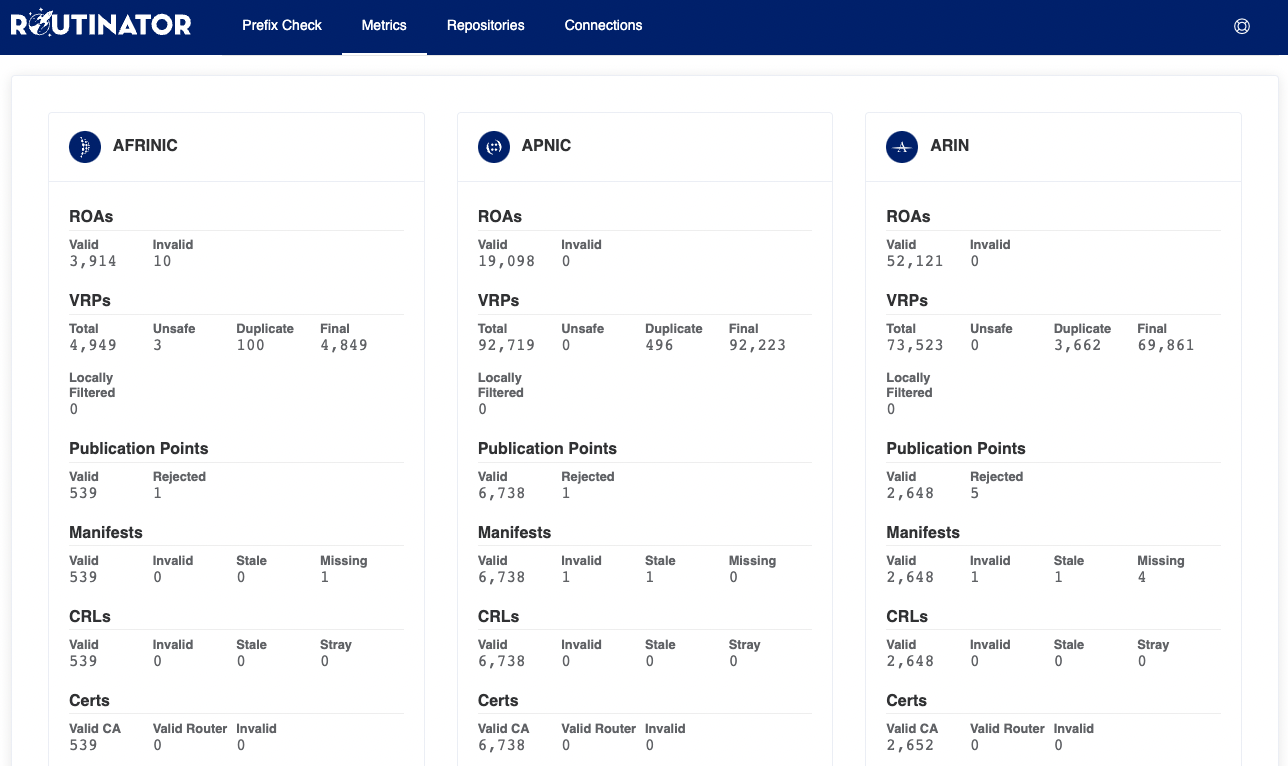
All RPKI objects (e.g. ROAs) are scattered as files in distributed repositories. These repositories make RPKI data available to RPs which periodically gather all authoritative data and maintain a complete view (by using rsync or rrdp for data retrieval). They then cryptographically validate the RPKI objects received, cache the result and relay as a valid prefix/origin AS bindings to routers for use in the validation process. The RPKI validators are usually based upon open source software. At the time of this writing, the best known and most used are the following:
- Routinator (https://nlnetlabs.nl/projects/rpki/routinator/)
- FORT (https://fortproject.net/en/validator)
- OpenBSD rpki-client (https://www.rpki-client.org)
- OctoRPKI (https://github.com/cloudflare/cfrpki)
- rpki.net rcynic (https://github.com/dragonresearch/rpki.net)
Connecting a router to the RPKI-to-Router interface
The RIPE NCC website5 provides extensive examples on how to configure routers to use an RPKI validator. The following basic examples are based on their documentation.
Juniper Networks JunOS
The first step is to connect the router to at least a single RPKI validator. The following lines will define that connection. After issuing the “commit” command the router will initiate the connection and start building up the validation database consisting of the VRPs (ROA Validated Payload) it receives from the validator.
routing-options {
  validation {
    group rpki-validator {
      session 192.0.2.2 {
        port 8282;
      }
    }
  }
}
At this point nothing has happened to the routing decisions yet, hence this step could be considered not service impacting.
Having a populated validation database the router can now start validating BGP updates it receives from it’s BGP neighbors. The following policy will actually start the validation process when applied as import policy.
policy-options {
  policy-statement route-validation
    term valid {
      from {
        protocol bgp;
        validation-database valid;
      }
      then {
        validation-state valid;
        accept;
      }
    }
    term invalid {
      from {
        protocol bgp;
        validation-database invalid;
      }
      then {
        validation-state invalid;
        reject;
      }
    }
    term unknown {
      from {
        protocol bgp;
        then {
          validation-state unknown;
          accept;
        }
      }
    }
  }
}
The ‘reject’ statement will actually drop received routes that are marked invalid based on the validation state. During the implementation phase It could be a good practise to not reject those routes yet.
The final step is to apply the policy to the BGP session:
protocols {
  bgp {
    group isp1-r1 {
      type external;
      import route-validation;
      export export-direct;

      neighbor 10.104.0.3 {
        peer-as 64510;
      }
    }
  }
}
5 https://www.ripe.net/manage-ips-and-asns/resource-management/certification/router-configuration
You can use the commands under show validation to check the sessions to the validator, the received data etc:
> show validation statistics
Total RV records: 1487
Total Replication RV records: 2946
  Prefix entries: 1382
  Origin-AS entries: 1487
  Memory utilization: 440802 bytes
Policy origin-validation requests: 13065187
  Valid: 35605
  Invalid: 37896
  Unknown: 12991686
BGP import policy reevaluation notifications: 27306
  inet.0, 27306
  inet6.0, 0
Nokia SR OS
The first step is to connect the router to at least one RPKI validator. The following lines will define that connection. After issuing the “commit” command the router will start building up the validation database consisting of the VRPs (ROA Validated Payload) it receives from the validator.
Classic CLI configuration:
A:br1-nyc>config>router>origin-validation# info detail
rpki-session 192.0.2.1
description "Routinator RPKI Server"
no shutdown
exit
MD-CLI configuration:
[ex:configure router "Base" origin-validation]
A:admin@br1-nyc# info
rpki-session 192.0.2.1 {
  admin-state enable
  description "Routinator RPKI Server"
}
At this point nothing has happened to our routing decisions yet, hence this step could be considered not service impacting. Using the validation database the router can now start validating BGP updates it receives from its BGP neighbors. The following policy will actually start the validation process when applied as import policy.
Classic CLI configuration:
A:br1-nyc>config>router>policy-options# info
  community "VRP_VALID_COMM" members "ext:4300:0"
  community "VRP_INVALID_COMM" members "ext:4300:2"
  community "VRP_NOT_FOUND_COMM" members "ext:4300:1"
  policy-statement "ORIGIN_POLICY"
    entry 10
      from
        origin-validation-state invalid
      exit
      action drop
        community add "VRP_INVALID_COMM"
        local-preference 90
      exit
    exit
    entry 20
      from
        origin-validation-state notFound
      exit
      action accept
        community add "VRP_NOT_FOUND_COMM"
        local-preference 100
      exit
    exit
    entry 30
      from
        origin-validation-state valid
      exit
      action accept
        community add "VRP_VALID_COMM"
        local-preference 110
      exit
    exit
  exit
MD-CLI configuration:
[ex:configure policy-options]

A:admin@br1-nyc# info
  community "VRP_INVALID_COMM" {
    member "ext:4300:2" { }
  }
  community "VRP_NOT_FOUND_COMM" {
    member "ext:4300:1" { }
  }
  community "VRP_VALID_COMM" {
    member "ext:4300:0" { }
  }
  policy-statement "ORIGIN_POLICY" {
    entry 10 {
      from {
        origin-validation-state invalid
      }
      action {
        action-type reject
        local-preference 90
        community {
          add ["VRP_INVALID_COMM"]
        }
      }
    }
    entry 20 {
      from {
        origin-validation-state not-found
      }
      action {
        action-type accept
        local-preference 100
        community {
          add ["VRP_NOT_FOUND_COMM"]
        }
      }
    }
    entry 30 {
      from {
        origin-validation-state valid
      }
      action {
        action-type accept
        local-preference 110
        community {
          add ["VRP_VALID_COMM"]
        }
      }
    }
  }
The ‘action-type reject’ statement will actually drop received routes that are marked invalid based on the validation state. During the implementation phase It could be a good practise to not reject those routes yet.
You can use the commands under show router origin-validation to check the sessions to the validator, the received data etc:
A:admin@br1-nyc# show router origin-validation rpki-session detail

===========================================================================
RPKI Session Information
===========================================================================

IP Address : 192.0.2.1
Description :
-------------------------------------------------------------------------------
Port : 8323                   Oper State : established
Uptime : 11d 07:28:50         Flaps : 0
Active IPv4 Records: 180746   Active IPv6 Records: 30095
Admin State : Up              Local Address : n/a
Hold Time : 600               Refresh Time : 300
Stale Route Time : 3600       Connect Retry : 120
Serial ID : 2737              Session ID : 10588
===========================================================================
Cisco IOS XE
The RPKI validator can be configured under the BGP routing process:
router bgp 64500
bgp rpki server tcp 192.0.2.2 port 8282 refresh 600
The router will now keep track of which routes are valid according to the ROAs, which routes are invalid and which routes aren’t covered by ROAs. You can use that in your routing policy:
route-map rpki permit 10 match rpki valid
set local-preference 999
You can use the commands under show bgp rpki to check the sessions to the validator, the received data etc:
# show bgp ipv4 unicast rpki servers
BGP SOVC neighbor is 192.0.2.2/8282 connected to port 8282
Flags 64, Refresh time is 60, Serial number is 60, Session ID is 914
InQ has 0 messages, OutQ has 0 messages, formatted msg 30
Session IO flags 3, Session flags 4008
Neighbor Statistics:
  Prefixes 25773
  Connection attempts: 250
  Connection failures: 244
  Errors sent: 0
  Errors received: 2

Connection state is ESTAB, I/O status: 1, unread input bytes: 0
Connection ECN Disabled, Mininum incoming TTL 0, Outgoing TTL 255
Local host: 192.0.2.1, Local port: 46721
Foreign host: 192.0.2.2, Foreign port: 8282
Cisco IOS XR
The RPKI validator can be configured under the BGP routing process:
router bgp 64500
  rpki server 192.0.2.2
    transport tcp port 8282
    refresh-time 600
The router will now keep track of which routes are valid according to the ROAs, which routes are invalid and which routes aren’t covered by ROAs. You can use that in your routing policy:
route-policy rpki
  if validation-state is valid then
    set local-preference 999
  endif
You can use the commands under show bgp rpki to check the sessions to the validator, the received data etc:
# show bgp rpki summary

RPKI cache-servers configured: 1 RPKI
global knobs
  Origin-AS validation is ENABLED globally
  Origin-AS validity WILL NOT affect bestpath selection globally
  Origin-AS validity signaling towards iBGP is DISABLED globally

RPKI database
  Total IPv4 net/path: 23854/24733
  Total IPv6 net/path: 3368/3507
Arista Networks EOS
Within the ‘router bgp’ context, the RPKI caches can be configured and RPKI origin-validation activated.
router bgp 65530
   rpki cache cache1
      host 192.0.2.1 port 8323
   !
   rpki cache cache2
      host 192.0.2.2 port 8323
   !
   rpki origin-validation
      ebgp local
      ibgp send
To see if the RPKI cache (RTR) connections have been established correctly and if the ROA state is ‘synched’ you can use the following commands:
# show bgp rpki cache
cache1:
Host: 192.0.2.1 port 8323
VRF: default
Refresh interval: 3600 seconds
Retry interval: 600 seconds
Expire interval: 7200 seconds
Preference: 5
Protocol version: 1
State: synced
Last update sync: 0:01:19 ago
Last full sync: 1:08:40 ago
Last serial query: 0:01:19 ago
Last reset query: 1:09:06 ago
Entries: 241240
Connection: Active (1:09:06)

cache2:
Host: 192.0.2.2 port 8323
VRF: default
Refresh interval: 3600 seconds
Retry interval: 600 seconds
Expire interval: 7200 seconds
Preference: 5
Protocol version: 1
State: synced
Last update sync: 0:23:06 ago
Last full sync: 0:48:59 ago
Last serial query: 0:23:12 ago
Last reset query: 0:49:06 ago
Entries: 241230
Connection: Active (0:49:06)

# show bgp rpki roa summary
   Cache              IPv4     IPv6
---------------- ------------ -----
   cache1           206370    34870
   cache2           206364    34866

Total ROAs in local database:
IPv4: 206376
IPv6: 34872
To enforce RPKI, this can be done either by using Route Control Functions (RCF) or Route Maps.
Example Route Map:
route-map RPKI deny 10
   match origin-as validity invalid
!
route-map RPKI permit 20
   match origin-as validity valid
   set local-preference 200
!
route-map RPKI permit 30
   match origin-as validity not-found
   set local-preference 100
!
router bgp 65530
   address-family ipv4
      neighbor 198.51.100.1 activate
      neighbor 198.51.100.1 route-map RPKI in
!
   address-family ipv6
      neighbor fc00::1 activate
      neighbor fc00::1 route-map RPKI in
Example Route Control Functions (RCF):
router general
   control-functions
      code
        function RPKI_CHECK() {
               if rpki.origin_as_validity is ROA_VALID {
                  local_preference = 200;
                  return true;
                  # Return = V and accept with LOCAL_PREF 200
               }
               if rpki.origin_as_validity is ROA_NOT_FOUND {
                  local_preference = 100;
                  return true;
                  # Return = U and accept with LOCAL_PREF 100
               }
               if rpki.origin_as_validity is ROA_INVALID {
                  return false;
               # Return = I and drop
               }
               return true;
            }

      EOF
!
router bgp 65530
   address-family ipv4
      neighbor 198.51.100.1 activate
      neighbor 198.51.100.1 rcf in RPKI_CHECK()
!
   address-family ipv6
      neighbor 2001:DB8::1 activate
      neighbor 2001:DB8::1 rcf in RPKI_CHECK()
Additional reading
Technical documentation on RPKI and the underlying protocols:
- The IETF SIDR working group (where RPKI is developed) https://tools.ietf.org/wg/sidr/
- An Infrastructure to Support Secure Internet Routing https://tools.ietf.org/html/rfc6480
- RPKI Relying Party tools https://rpki.net/wiki/doc/RPKI/RP
- RIPE NCC RPKI Validator https://www.ripe.net/manage-ips-and-asns/resource-management/certification/tools-and-resources - https://labs.ripe.net/Members/nathalie_nathalie/life-cycle-of-the-ripe-ncc-rpki-validator-1
- Dragon Research Labs RPKI Toolkit https://github.com/dragonresearch/rpki.net
- Cisco: IOS XE - BGP Configuration Guide - Origin AS Validation http://www.cisco.com/c/en/us/td/docs/ios-xml/ios/iproute_bgp/configuration/xe-16/irg-xe-16-book/bgp-origin-as-validation.html
- Cisco IOS XR - BGP Prefix Origin Validation Based on RPKI http://www.cisco.com/c/en/us/td/docs/routers/asr9000/software/asr9k_r4-2/routing/configuration/guide/b_routing_cg42asr9kb_routing_cg42asr9k_chapter_00.html#concept_A84818AD41744DFFBD094DA7FCD7FE8B
- Juniper Networks: Configuring BGP Origin Validation using RPKI https://www.juniper.net/documentation/en_US/release-independent/nce/topics/topic-map/nce-187-bgp-rpki-tn-overview.html
- Nokia SR OS: BGP Prefix Origin Validation https://infocenter.alcatel-lucent.com/public/7750SR160R4A/index.jsp?topic=%2Fcom.sr.unicast%2Fhtml%2Fbgp.html&cp=22_4_7_2&anchor=d2e5366
Path validation
Path validation seeks to validate the AS_PATH attribute of an observed prefix announcement. For these purposes, a path is considered valid if it is consistent with the intended routing policies of each AS traversed by the path. Such validation therefore requires that an authoritative description of each ASNs routing policy be made publicly available.
The automated validation (with certain limitations) of an observed AS_PATH can be achieved by logically “chaining together” the documented policies of the individual ASs in the path.
MANRS participants should therefore express their own policy as thoroughly as possible to facilitate validation by 3rd party networks.
At the very least, as noted above, any operator that provides transit services to potentially multi- homed customer networks (irrespective of whether those customers operate an AS) should implement a filtering mechanism on outbound announcements towards its non-customer peers to ensure that only customer prefixes that are being learnt directly from customers (rather than via some other intermediate network) are propagated onwards.
Whilst it is possible to construct AS_PATH filters describing all the possible valid customer paths, such an approach may scale poorly over time given the tools available today. An alternative approach is to append a community attribute to routes received from customers as they are imported, and to configure outbound filters towards non-customer peers to match only routes carrying the correct community attribute (in addition to prefix-based matching as described above).
Summary
Being a responsible network operator requires the publishing of your own contact and routing policy information, and using the information published by others to verify the information in the routing table.